
Permits
The order of works on a Melton knockdown
A demolition permit for a Melton council knockdown is one step in a sequence, not the whole sequence. People ring us asking for a Thursday, then discover the services are still connected, the surveyor has not been engaged, and nobody has decided whether the slab stays. The machine is the easy part to picture. The order of works is what stops the machine sitting in the driveway while everyone makes phone calls. This is the order we actually use.
Decide the job before you book the day
Write down what is going and what is staying. House, garage, shed, driveway, trees, fences. Write down the finish: slab left, slab out, or a site cut to levels. If you cannot fill those in, you can still ask for a quote, but you cannot sensibly lock a demolition day. We would rather quote the options than pretend a single price covers three different endings. Put the slab date the builder is hoping for on the same note. If that date is already next week and the services are still live, the date is the thing that has to move, not the safety steps in front of the machine.
Talk to the builder or building surveyor about the permit pathway at the same time. Melton sits with Melton council. A house knockdown usually needs a building permit. We do not issue permits, we do not run council, and we do not guess whether an overlay applies to your block. Your surveyor does that. What we need from you is a clear yes that the pathway is open before we schedule the knock.
Isolate services and clear the house
Power, gas, water and communications are isolated before we start. Who books the disconnections is a question to settle early, because those authorities do not work to a demolition crew’s preferred morning. A house with live power is not a house we pull. The same goes for gas. Get the dates, and tell us what has actually been done, not what was requested. A confirmation that someone lodged the form is not the same as the meter being gone or the line being cut. We will ask which one it is.
Empty the building of anything you still want. That includes the shed, if the shed is going. Paint, fuel, gas bottles and leftover chemicals come out. If asbestos might be in the house, an assessment comes before the knock, and licensed removal comes before we create waste. Mark trees and fences that stay. Tell the neighbours the week will be loud. None of this is paperwork for its own sake. It is the difference between a clean start and a morning spent standing around.
The demolition day
Fencing goes up where the site needs it. The excavator takes the structure down. Roofing and steel are loaded with a grapple into our hooklift bins. If the slab is coming out, that follows the structure, and the concrete is kept as its own stream. If a garage or driveway was on the list, it is part of the same visit only because it was on the list. It is not added because the machine still has fuel. Leave a structure you still need for a later visit.
A straightforward Melton house is often a day on the tools, with trucks timed around the pull. Clay, a tight court, a pool or extra concrete will stretch it. We will have said so. If something unexpected appears — a tank, a pit, a second slab — we stop and call. You should not find that out as a surprise line later. You should find it out while there is still a choice.
After the house: the ground
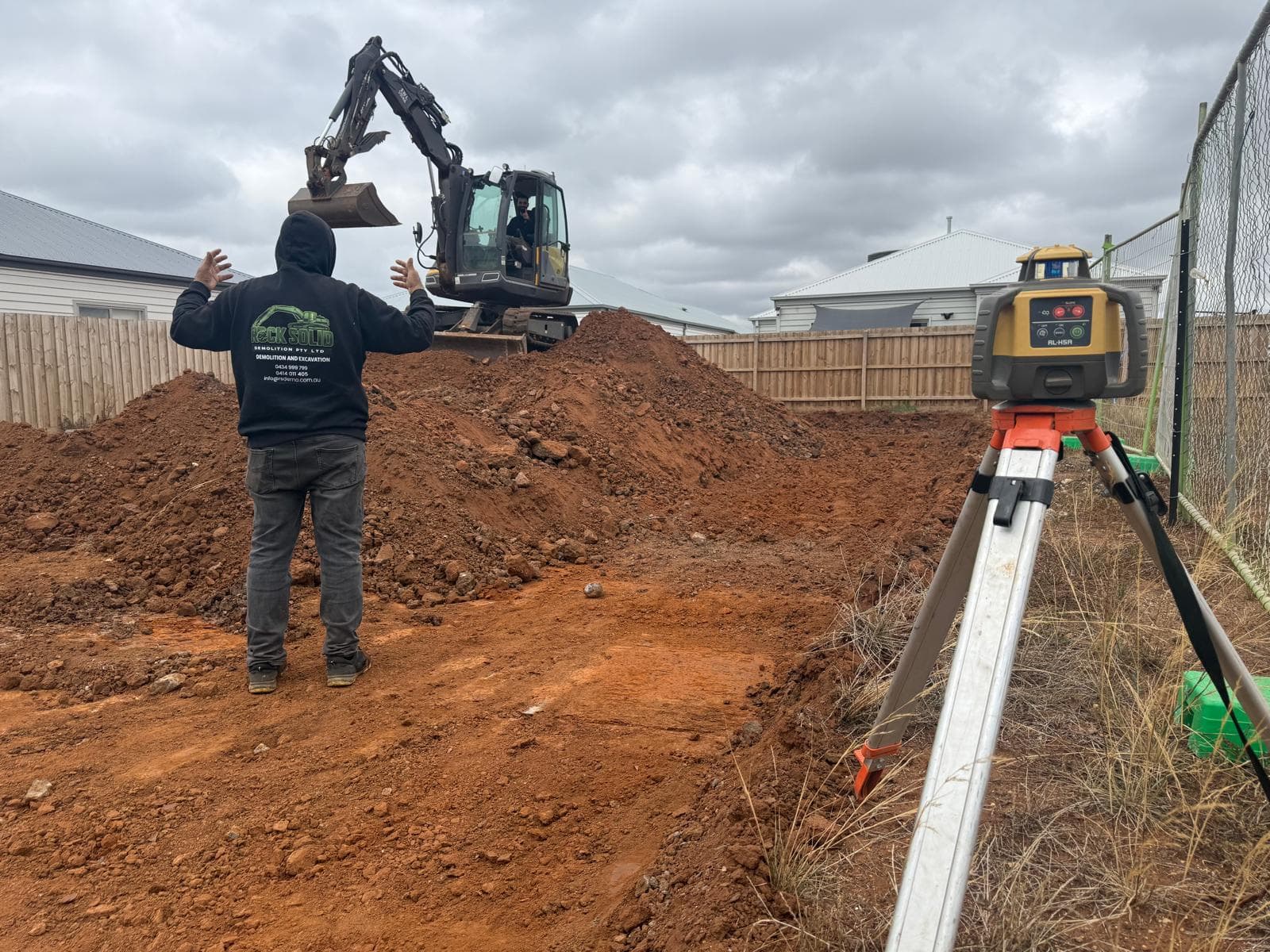
When the building is gone, the block is either finished or it is ready for the cut. Finished, for a slab-left or slab-out job, means the agreed surface is clear and walkable. A site cut is the next task when the new house needs different levels. The excavator digs the clay, a laser level checks the grade, and a crew member directs the operator. We can do that ourselves. It has to be in the quote, and the levels have to exist.
Do not stack the concreter on the same afternoon unless the site really is that simple and the weather is on your side. A few days between demolition and the next trade is a normal buffer. If it rains, Melton clay will tell you why. Book the cut and the knockdown together when you can. Split them when the engineer is not ready. Both are better than a crew inventing a level because a slab truck is already booked.
Waste, then the handover
Waste is sorted on site and taken to licensed recycling and disposal facilities in Melbourne's west, with concrete, brick, metal and timber separated for recycling wherever possible.
Spoil from a cut is carted as soil, not mixed through the rubble. When we leave, the bins are gone, the finish matches the instruction, and you can hand the block to the builder without a weekend of tidying. That is the end of our order of works. Permits for the new building, the new slab, and the inspections that belong to those trades are the builder’s order of works, and they start properly only when this one has actually finished. If you want the fencing left up for that next trade, say so before we roll out. Taking it down and putting it back up a week later is a waste of the same hire.
Quick answers
The short version, if you skipped the scan.
Does a Melton knockdown need a permit?
A house knockdown usually needs a building permit. Melton is in Melton council’s area. We do not issue the permit. Your building surveyor confirms the pathway, including any overlay.
What has to happen before you can start?
The scope and the finish are agreed, the permit pathway is clear, services are isolated, and the house is empty of anything you are keeping. If asbestos has to be removed, that is done by a licensed remover first.
Can the site cut happen on demolition day?
Yes, when the levels are already issued and the cut is in the quote. If the levels are not ready, we take the house and come back.
Who do I talk to at council?
Your building surveyor leads the permit. We can tell you what the demolition day looks like from the site. We cannot lodge or approve the permit for you.
Get a free quote
Suburb, photos, and what you want left behind. We call back within one business day.
Prefer to talk now
0434 999 799Or email info@rsdemo.com.au