Process
What happens after demolition: the site cut
The house coming down is the loud part. Site preparation after demolition is what decides whether the concreter, the plumber or the builder can actually start. On a knockdown in Melbourne's west we are often asked to leave the slab, take the slab, or cut the clay to a new level. Those are different finishes, and they need to be named before the machine arrives. This is the sequence we use, from the last load of the old house to a clear, levelled site.
Name the finish before the knockdown
Ask the builder, in writing, what they want to walk onto. Slab left means the house floor stays and the new work starts from it. Slab out means the floor goes with the house and you are left with ground. A site cut means the ground itself is dug to a level the new house needs, which is not the same thing as simply removing the old floor. If nobody has said which of those three is required, the quote is a guess and the programme will slip.
Photos help, but they do not replace that decision. Send a photo of the street, the front of the house, and the backyard, and say what stays: a garage, a shed, a fence, a tree, a path. Say whether the new slab is higher or lower than the old one. If you do not know yet, say so. We can price the knockdown and note the cut as a separate line once the engineer’s levels exist. What we will not do is invent a level on the day.
What the knockdown leaves behind
A straightforward house is often a day on the tools, with cartage wrapped around it. Temporary fencing goes up where the site needs it. Services — power, gas, water and communications — are isolated before anything is pulled. The excavator takes the structure down. Roofing and steel are lifted with a rotating grapple into our own hooklift bins, rather than dragged into a heap across the neighbour’s crossover.
When the building is gone you can see the block properly for the first time. That is when hidden things show up: a second slab under a verandah, a septic tank, a pit, a strip footing that runs further than the plans suggested. We stop and call before the price moves. The finish you asked for is then the job that remains. Ready for the next trade means they are not climbing a brick pile. It does not mean we poured their blinding or connected their stormwater.
What a site cut actually is
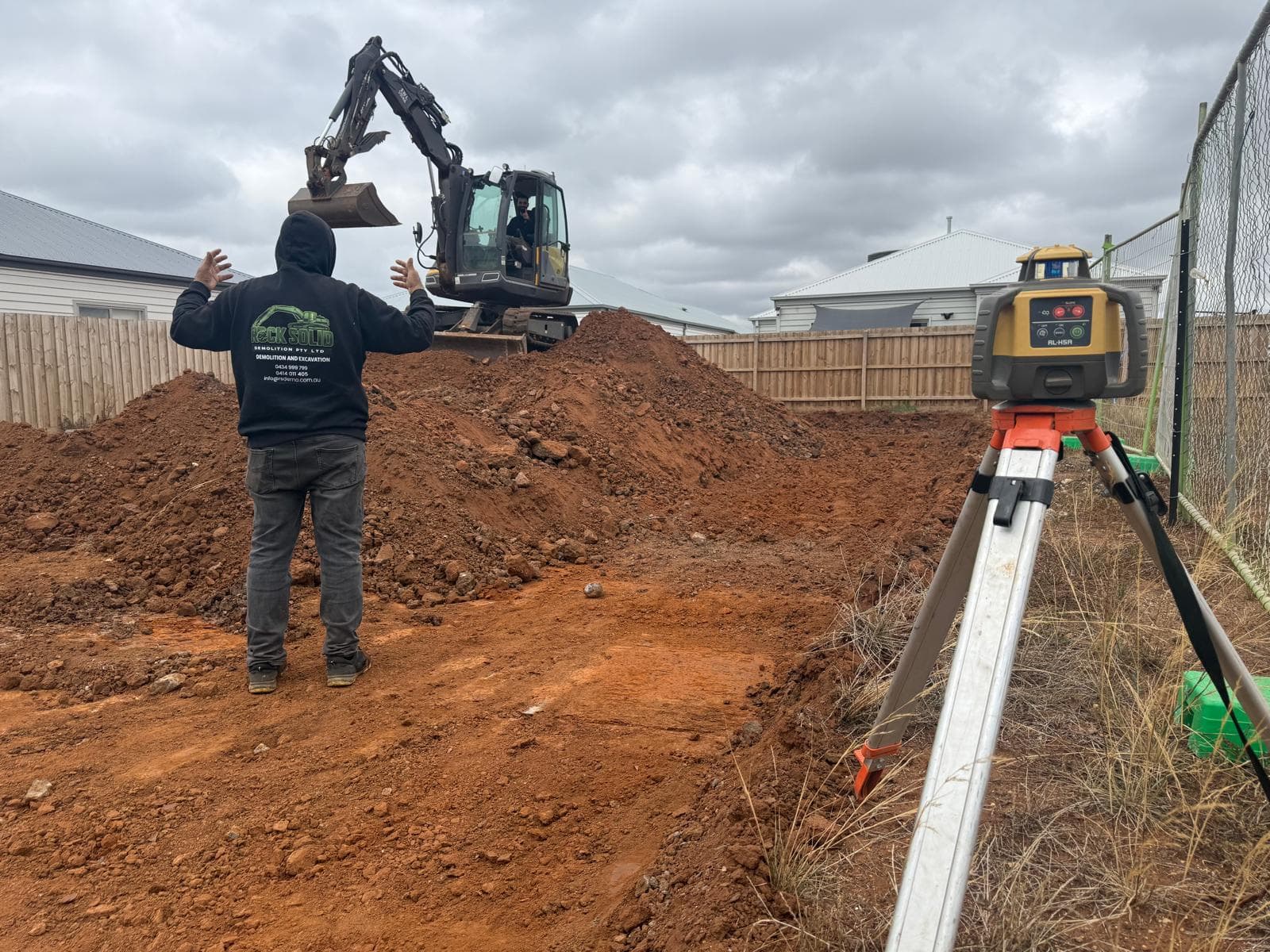
A site cut is excavation. The excavator digs the clay with a bucket. A rotating laser level on a tripod is how the grade is checked, and a crew member stands clear of the bucket and directs the operator. The aim is a surface that matches the levels you were given, not a surface that merely looks flat from the street. Red clay in Melbourne’s west holds water, marks easily, and will rut if trucks keep driving on the finished level. We plan the cartage so the last loads are not chewing up the grade we just cut.
We are a demolition and excavation company, so the cut can stay with the same crew that took the house down. That only works when the cut is in the quote. If the engineer has not issued levels, we can take the house and leave a tidy block, then come back for the cut when the numbers exist. Booking both in one visit is better when the information is already there, because the machine is on site and the fencing is already up.
Handing the block to the next trade
The useful handover is boring. The block is clear. The finish matches what was asked: slab, dirt, or a cut to the stated levels. Fencing is still doing its job or has been taken down because you asked for that. Bins are gone. The crossover has been scraped rather than left with a trail of clay. You can walk it in work boots. If a garage or shed was in the same visit, it is gone too, and its slab is either still there or out, matching the same instruction as the house.
Give the next trade a buffer. Same-afternoon concrete after a knockdown and a cut is a fantasy except on the cleanest sites in good weather. A few days is adult. A week is comfortable, especially if it rains and the clay needs to stand. Tell us the slab date when you book, and we will tell you whether the sequence is realistic. If it is not, it is cheaper to hear that before the machine is booked than on the morning the concreter arrives.
What to send with the quote
The short list is enough to price most houses. Suburb, photos of the street and the structure, what should be left, and whether you want slab, dirt or a cut. If you have a site plan or a set of levels, attach them. If a building permit is already in, say so. If asbestos might be in the house, say that too. We do not start a knockdown on a maybe, and licensed removal sits in front of the knock when a report says it has to.
Waste is sorted on site and taken to licensed recycling and disposal facilities in Melbourne's west, with concrete, brick, metal and timber separated for recycling wherever possible. Soil from a cut is not the same stream as that building waste, and it is priced and carted as spoil rather than as demolition rubble. If both are on the one job, say so at the start so the bins and the trucks are the right ones. We are based in Melton and this work is the ordinary run across Melbourne’s west.
Quick answers
The short version, if you skipped the scan.
Is a site cut part of the house demolition?
Only when it is in the quote. Taking the house down and cutting the clay to an engineer’s level are different tasks. We can do both, because we demolish and excavate, but the cut needs levels and it needs to be booked.
Can you leave the block levelled in the same visit as the knockdown?
Yes, when the finish and the levels are known before we start, and the weather lets the clay hold. If the levels are not issued yet, we take the house and come back for the cut.
What do you need before you can price site preparation?
Photos, the suburb, what should stay, and the finish you want. A site plan or engineer’s levels makes a cut price real. Without them we can still price the knockdown and note the cut as a later line.
Do you remove the old house slab as part of site preparation?
If you ask for slab out, yes. If you ask for slab left, the floor stays. Say which one. A site cut is a further step, on the ground under or beside that slab, and it is not assumed.
Get a free quote
Suburb, photos, and what you want left behind. We call back within one business day.
Prefer to talk now
0434 999 799Or email info@rsdemo.com.au